Summary
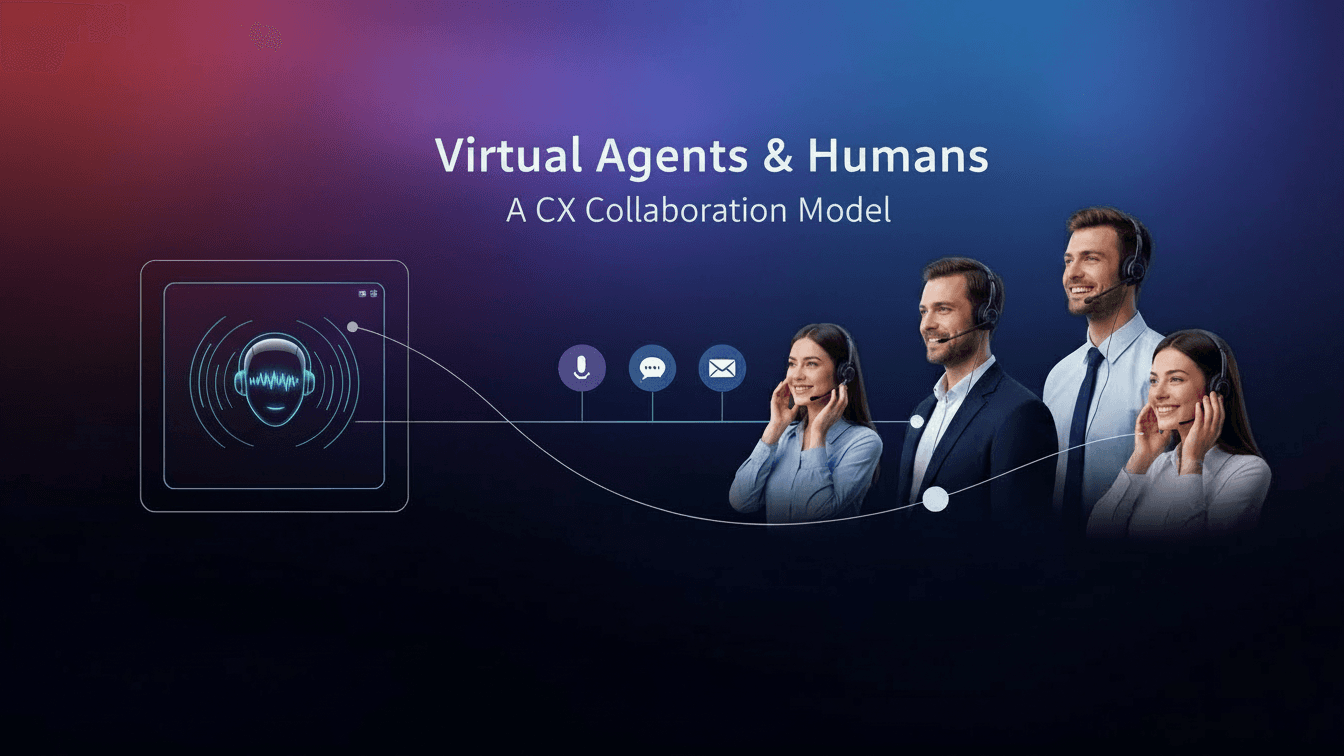
Contact centers today struggle to balance high interaction volumes with the demand for personalized, 24/7 support. The most effective solution is a hybrid collaboration model where virtual agents manage routine inquiries, allowing human teams to focus on complex, empathy-driven conversations. By orchestrating this partnership effectively, organizations can scale operations and reduce costs while delivering a faster, more satisfying customer experience.
Virtual Agents + Human Agents: A Real-World Collaboration Model That Works
The modern contact center faces a seemingly impossible equation. Interaction volumes are climbing steadily, customers expect immediate responses at 2 a.m. on a Tuesday, and retention rates for skilled support agents are plummeting. To cope, many organizations rushed to deploy automation, often with mixed results. The outcome? Customers stuck in endless loops with rigid bots, shouting "representative" until they are routed to an exhausted human agent who has no context for their frustration.
This friction stems from a fundamental misunderstanding. The challenge isn't choosing between automation and human support; it is designing an operational model where they function as a cohesive unit. We are moving past the era of "AI vs. Humans" into an era of orchestration. The most successful customer experience (CX) strategies today don't just deploy virtual agents to deflect calls; they deploy them to empower human agents. This collaboration model is the only scalable way to meet modern expectations without burning out your workforce or blowing up your budget.
Why the Binary Choice Fails
For years, the industry oscillated between two extremes: the human-centric legacy model and the automation-first aggressive model. Both have structural flaws that make them unsustainable in the current market.
The Limits of AI-Only CX
Automation without guardrails creates friction. When organizations prioritize deflection rates over resolution quality, they deploy bots that are overconfident and under-capable. These systems often lack the nuance to understand intent shifts or emotional distress. A customer trying to resolve a billing error for a deceased family member, for example, needs empathy, not a pre-programmed rigid workflow. When AI is forced to handle these interactions alone, customer sentiment nosedives, and churn increases. The efficiency gained by the bot is lost the moment the customer walks away from the brand entirely.
The Unsustainability of Human-Only CX
Conversely, relying solely on human effort is no longer mathematically viable for most enterprises. As interaction volumes grow, scaling a human team linearly is prohibitively expensive. Beyond the cost, there is the human toll. When highly trained agents spend 40% of their shift answering "Where is my order?" or "What are your hours?", their cognitive load is wasted on low-value tasks. This repetition drives burnout and attrition. A human-only model during peak seasons or unexpected surges typically results in massive wait times, frustrating customers before the conversation even begins.
The solution lies in the middle ground: a hybrid environment where the strengths of one offset the weaknesses of the other.
The Real-World Collaboration Model
High-performing CX teams view virtual agents and human agents as colleagues with distinct job descriptions. The goal is not to replace the human, but to elevate their role by filtering out the noise. This requires a clear division of labor based on complexity and empathy.
The Role of the Virtual Agent
In a collaborative model, the virtual agent acts as the frontline filter and the taskmaster for routine operations. It is available instantly and infinitely scalable. Its primary responsibilities include:
- High-volume, repeatable requests: Handling standard inquiries that require data retrieval but no judgment calls, such as order tracking or balance checks.
- Triage and intent recognition: Identifying why a customer is calling and routing them to the correct department or resolving the issue immediately if it falls within set parameters.
- Transactional tasks: Executing bookings, appointment changes, and simple account updates that follow a strict logic flow.
- After-hours coverage: Providing support continuity when human teams are offline, ensuring customers can still complete basic tasks or log tickets for morning review.
- Overflow management: Acting as a buffer during demand spikes to ensure every customer is acknowledged immediately, even if human wait times are long.
The Role of the Human Agent
By offloading the transactional volume to AI, human agents are freed to operate at the top of their license. Their role shifts from "transaction processor" to "problem solver" and "relationship builder." Their responsibilities focus on:
- Emotional and sensitive conversations: Managing interactions that require empathy, such as complaints, complex disputes, or support for vulnerable customers.
- Judgment-based decisions: Handling "grey area" scenarios where company policy might need to be interpreted or bent to save a customer relationship.
- Exceptions and complex resolutions: solving multi-layered problems that fall outside the training data of the virtual agent.
- High-value sales and retention: Engaging in conversations where persuasion, negotiation, and rapport are critical to the business outcome.
In this model, AI is the first line of defense, but humans remain the ultimate authority on customer satisfaction.
Why Seamless Handoffs Matter
The single biggest failure point in a hybrid model is the transition. We have all experienced the frustration of giving our account number and issue details to a bot, only to have a human agent pick up the line and ask, "Can I have your account number and reason for calling?"
This is not a technology failure; it is a process failure. Customers generally accept speaking to a bot if it solves their problem. What they do not accept is repeating themselves.
Context is Currency
A seamless handoff transfers more than just the call; it transfers the context. When a virtual agent escalates an interaction, the human agent should receive a full transcript or summary of what has already occurred. They should know the customer was authenticated, they should know the intent (e.g., "billing dispute"), and they should know exactly where the bot got stuck.
Invisible Escalation
The goal is for the escalation to feel like a natural progression of the service, not a failure of the system. An "invisible" escalation means the customer doesn't feel like they are starting over. The human agent picks up exactly where the bot left off, perhaps saying, "I see you're asking about the charge on March 14th; let me look into that for you."
This continuity builds trust. It tells the customer that the organization values their time. Without this data continuity, the efficiency gains of the virtual agent are negated by the increased handle time and frustration of the human interaction.
What “Human-in-the-Loop” Really Means
"Human-in-the-loop" is often treated as a technical safety net—a way for a human to step in when a bot fails. While that is part of it, true leadership views it as a governance principle.
Humans are not just a fallback; they are the teachers and supervisors of the AI workforce. Just as a senior manager reviews the work of a junior employee to help them improve, human agents and supervisors must maintain oversight of virtual agent performance.
Continuous Improvement Loop
In a mature CX operation, human feedback drives AI evolution. When a human agent takes over a call, they should be able to tag why the escalation happened. Was the bot confused? Was the policy outdated? Did the customer use a phrase the AI didn't recognize?
This data feeds back into the system. Supervisors review these interactions to retrain the virtual agent, refining its understanding and expanding its capabilities. This creates a virtuous cycle where the AI handles more over time, and humans are consistently pushed toward higher-value work. This oversight also ensures compliance and brand safety, preventing the "hallucinations" or errors that can occur with unchecked automated systems.
The Business Impact of a Hybrid CX Model
Adopting a collaborative model isn't just about smoothing out operations; it delivers measurable business impact across key performance indicators.
- Reduced Cost to Serve: By automating 30-40% of routine interactions, the average cost per contact drops significantly. Virtual agents cost a fraction of a human interaction, allowing budget to be reallocated toward better tools, training, or retention for the human staff.
- Faster Time to Resolution: Customers with simple problems get answers instantly, rather than waiting in a queue. Customers with complex problems get through to humans faster because the queue is no longer clogged with password resets. Both segments experience a reduction in effort.
- Improved Customer Satisfaction (CSAT): Speed and competency drive satisfaction. When customers can self-serve on their own terms but easily reach a human when they need one, their perception of the brand improves. They feel empowered, not blocked.
- Reduced Agent Burnout and Churn: This is perhaps the most overlooked benefit. When you remove the repetitive drudgery from a human agent's day, their job satisfaction improves. They are engaged in work that actually requires their intellect and empathy. This leads to lower attrition rates, preserving institutional knowledge and reducing recruiting costs.
- Elastic Scalability: A hybrid model allows businesses to breathe. During a product launch or a service outage, the virtual agent layer can absorb the massive spike in volume, filtering and prioritizing calls so the human team doesn't drown. It provides operational resilience that a human-only model simply cannot match.
The future of the contact center isn't about replacing people. It is about building a structure where technology handles the scale, and people handle the significance. By getting the collaboration right, organizations can finally deliver the responsive, empathetic experience their customers demand.
About Flow9: Humanizing the Customer Experience
Flow9 is dedicated to the mission of humanizing customer experience through intelligent automation. We believe that automation should not create barriers between businesses and their customers, but rather remove the friction that prevents meaningful connection.
Flow9 Engage serves as a front-line AI contact center platform designed to orchestrate the collaboration between virtual agents and human teams. By supporting hybrid workflows across voice, chat, and email, the platform ensures that high-volume, routine inquiries are resolved instantly, allowing human agents to focus on the complex issues that require empathy and judgment.
Key capabilities include:
- Seamless, Context-Rich Handoffs: When an interaction requires human intervention, Flow9 transfers the full conversation history and intent data. This ensures the human agent picks up exactly where the virtual agent left off, eliminating the need for customers to repeat themselves.
- Omnichannel Support: The platform unifies the customer journey across voice, chat, and email, maintaining consistency regardless of the communication channel.
- Deep Integration: Flow9 integrates directly with existing CRM and contact center systems, allowing organizations to deploy intelligent automation layers without ripping and replacing their core infrastructure.
This approach enables enterprise teams to scale operations efficiently while maintaining the high standards of care and personalization that modern customers expect.
Tags
Subscribe to the Flow9 Blog
Get the latest AI voice insights, product updates, and industry stories delivered straight to your inbox — no fluff, no spam.
Join the conversation
Comments (0)
Be the first to comment.